Pinterest Affiliate Programs: How to Choose the Right One
Learn how to choose the right affiliate program for Pinterest by comparing commissions, cookie duration, requirements, product fit, and audience demand.
Before starting a Pinterest account for affiliate marketing, it may be tempting to jump straight into creating pins.
You find a niche.
You make a few boards.
Then you start looking for products you can promote.
That approach can work, but I think it is often smarter to research potential affiliate programs before you spend a lot of time creating content.
This does not mean you need to have every detail figured out before posting your first pin. However, doing some early research can help you avoid problems later.
Some affiliate programs have follower or impression requirements. Others want your account to focus on a certain topic. A company may also judge your application based on the quality of your content, the type of audience you have, or the platforms you plan to use.
Some programs may not even allow direct affiliate links on Pinterest.
That is something you probably want to know before you spend weeks building content around the company’s products.
Affiliate programs also do not all work the same way.
Some companies offer recurring commissions, meaning you continue earning money for as long as the customer remains subscribed. This is common with software and other subscription products.
Other companies pay you a one-time percentage of the sale. Amazon is a common example of this type of program.
The exact commission rates and terms can change, so you should always read the current program information before applying.
Start With Your Niche and Audience
You most likely already have a niche picked out.
However, on the off chance that you do not, I would not recommend searching for the highest-paying recurring affiliate program and building your entire account around it.
Instead, I would base your decision on two main questions:
Do you actually enjoy creating content about the niche?
And is there an audience for it?
Both questions matter.
You could find a program that pays a large commission, but that will not help much if you hate talking about the product. It is going to be difficult to consistently create useful content about something you do not care about.
At the same time, enjoying a topic does not automatically mean there is a large audience waiting to buy products from you.
You need some balance between personal interest and market demand.
How to See Whether Your Niche Has an Audience
There are a few free ways to get an idea of how popular a niche is on Pinterest.
The first option is Pinterest Trends.
Search for keywords connected to your niche and see whether people are actively looking for them. You can also compare related keywords to see which topics receive more interest.
The second option is simply using Pinterest itself.
Type a keyword from your niche into the Pinterest search bar and look at the results. Open some of the top pins and see what kind of engagement they receive.
Look at things such as saves, comments, and shares.
You should also pay attention to the type of content that appears repeatedly. This can give you an idea of what people in that niche are interested in.
For a paid option, one tool that may be helpful is Pin Inspector.
Pin Inspector gives you access to more Pinterest data than you would normally see through Pinterest itself.
For example, the image below shows a search for smoothie pins. You can compare individual pins using information such as saves, shares, repins, and comments.
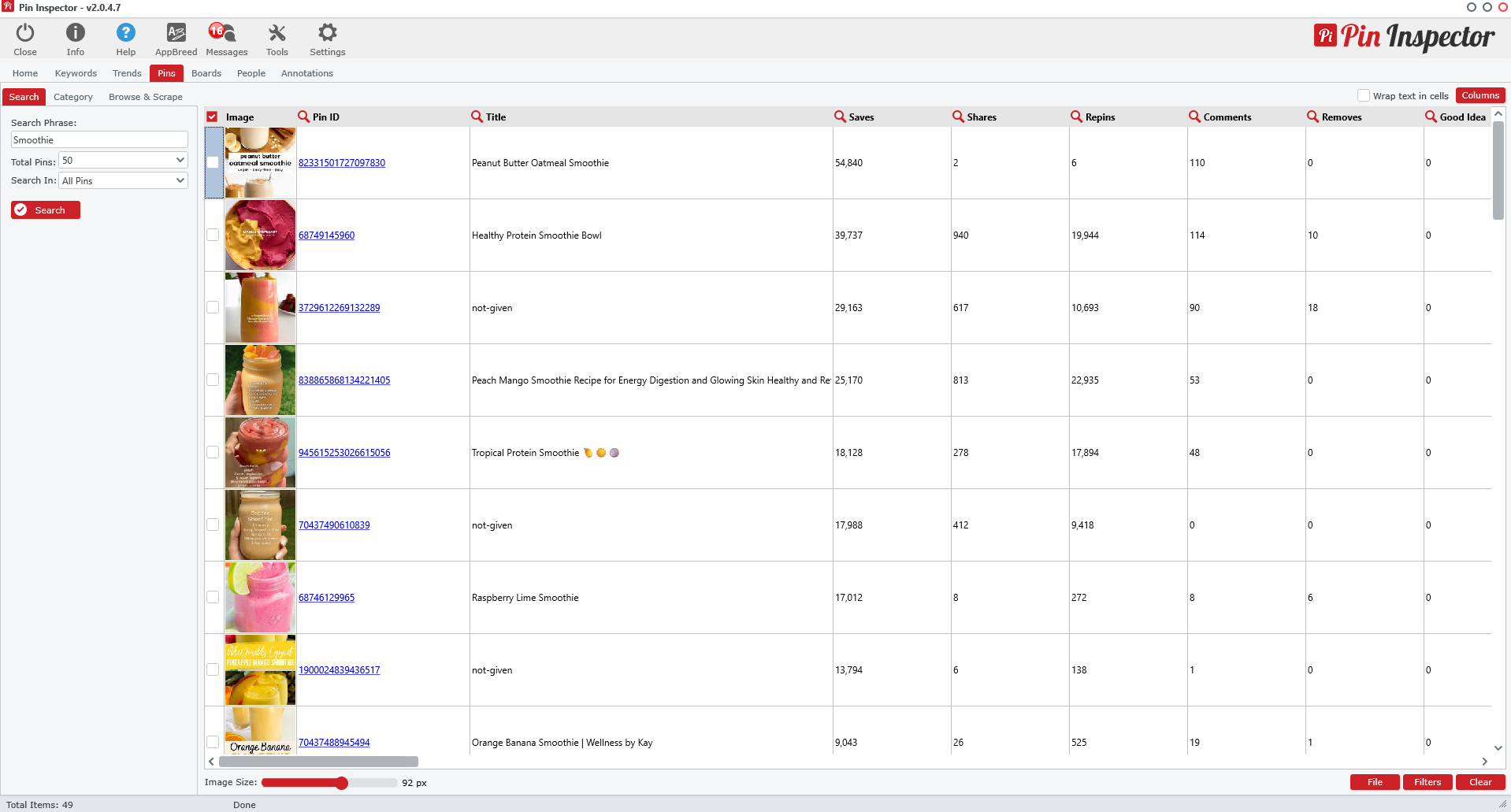
Example: Comparing smoothie pins in Pin Inspector
This can help you see which types of content are already receiving attention in your niche.
Of course, finding an active audience is only part of the process.
You should also think about what that audience would realistically buy.
A program can offer a great commission, but that does not matter much when the product has nothing to do with the people following your account.
Should You Choose a Program Based on the Payment Model?
This is a question almost every new affiliate marketer runs into.
Should you choose a recurring commission program or a program that pays once per sale?
My answer is no.
You should not choose an affiliate program based only on how it pays.
Recurring commissions sound great, and they certainly can be. You refer one customer, that customer stays subscribed, and you continue receiving part of the payment.
However, many of the higher-paying recurring programs are connected to technology and software.
That works well when you enjoy creating content about technology.
But what happens when your real interest is gardening?
You may find a software program with an impressive commission, but forcing yourself to make technology content just for the money will probably become exhausting.
Eventually, you may lose interest and stop posting altogether.
I also think people overlook one-time commission programs.
A one-time payment does not automatically mean the program is bad.
For a simple example, imagine your blog receives 5,000 visitors in one month. Around 2% of those visitors purchase a $50 product.
That would give you 100 sales.
With a 15% commission, you would earn $7.50 from each sale. That comes out to $750 for the month.
The payment may not be recurring, but $750 is still $750.
My point is that the product and audience fit usually matter more than whether the payment is recurring or one time.
A product that your audience genuinely wants can perform much better than a high-paying product that does not match them.
Make a List of Companies You Would Recommend
Once you understand your niche and audience, make a list of five or six companies in your industry.
These should be companies whose products you would feel comfortable recommending.
You can make the list on paper, in a notes app, or in an Excel spreadsheet. It really does not matter.
The important part is thinking beyond the commission rate.
Ask yourself whether you would be comfortable telling another person to spend their money on the product.
After making your list, visit each company’s website and scroll down to the footer.
Look for links with names such as:
- Affiliate Program
- Partner Program
- Referral Program
- Join Our Program
When you open the affiliate page, the company may ask for your email address, website, social media accounts, follower count, traffic numbers, and information about how you plan to promote its products.
This is also why I recommend choosing more than one company.
Established companies with strong products can be selective about where and how those products are marketed.
For example, imagine applying to a large fashion brand when your account has fewer than 100 followers, only a few thousand monthly impressions, and content that is still trying to find its main message.
The company may not have much reason to accept you yet.
That does not mean your account is bad.
It may simply mean you need more time to build it.
Having five or six possible companies gives you other options when one program says no or does not respond.
Compare the Full Program Terms
Do not compare affiliate programs using only the commission percentage.
A company offering a 30% commission may sound better than one offering 10%, but the percentage does not tell you everything.
You should also look at:
- Whether the commission is recurring or one time
- The cookie duration
- The minimum payout amount
- How often payments are sent
- Whether refunds can reverse your commission
- The price of the product
- How difficult the product may be to sell
- The tools and support given to affiliates
Some companies provide affiliate images, custom links, tracking dashboards, product information, and a support team.
Others may give you a link and leave you to figure out everything else.
These details can make a major difference once you begin promoting the product.
You should also look at the product’s price.
A higher-priced product may give you a larger commission, but it may also be harder to sell. A cheaper product may pay less per purchase but convert more easily.
Once again, there is no single payment model or price range that is automatically best.
It depends on the product, the audience, and the type of content you create.
What Is Cookie Duration?
Cookie duration is basically the amount of time a company tracks someone after that person clicks your affiliate link.
For example, imagine a program has a 30-day cookie.
Someone clicks your link today but does not purchase the product immediately. Instead, they wait two weeks before returning to the website and buying it.
Because the purchase happened within the 30-day window, you may still receive the commission.
The exact outcome depends on the program’s rules. You may lose credit when the person clicks another affiliate’s link before making the purchase.
Still, a longer cookie duration generally gives you more time to receive credit for the sale.
Cookie duration matters because most people do not buy something the first time they see it.
They may compare several products.
They may read reviews.
They may wait until payday.
They may simply need some time to think about whether the product is worth buying.
A longer cookie duration gives you a better chance of receiving credit after doing the work of introducing that person to the product.
Check the Requirements Before Applying
Before applying, carefully check the program requirements.
Look for rules involving:
- Follower count
- Monthly website traffic
- Account age
- Content quality
- Location
- Audience type
- Allowed promotional platforms
This last one is especially important for Pinterest affiliates.
Some programs allow affiliate links inside blog posts but do not allow you to place those links directly on Pinterest or other social media platforms.
You can search Google or ask an AI tool for a general explanation, but the best source will always be the company’s official website and current affiliate terms.
When the rules are unclear, contact the company directly.
It is better to ask before promoting the product than to build an entire strategy around a method the company does not allow.
Once you find a program that fits your account, you can apply through its affiliate program page.
Response times will vary.
Some companies may respond within a few business days. Others may take several weeks. Some may never respond at all.
Unfortunately, that is just part of affiliate marketing.
What Should You Do If You Get Rejected?
Getting rejected from an affiliate program does not mean you should give up on the company forever.
One valuable piece of advice I received was to build your profile and then apply again later.
Use that time to grow your following, increase your monthly impressions, improve your content, and prove that people are interested in what you post.
When you return, you will have more evidence that you can send potential customers to the company.
Your account may also look more professional and focused.
However, you may not want to wait several months before earning your first affiliate commission.
In that case, look for programs with easier entry requirements.
The Amazon affiliate program is one common example because Amazon sells products in many different categories, including home decor, fashion, technology, gardening, and more.
This can make it easier to find products that fit your niche while you continue building your account.
Just remember to check the current rules and commission rates before joining.
A Few Final Tips for Beginners
Try to research or personally use a product before heavily recommending it.
You do not need to own every product you ever mention. However, you should understand what the product does, who it is for, and whether it has a good reputation.
Your audience’s trust is worth more than a large commission.
Promoting a bad product may earn you money once, but it could make people question every recommendation you make afterward.
You should also clearly disclose affiliate links.
Tell readers that the link is an affiliate link and that you may earn a commission when they make a purchase.
Do not hide the disclosure at the bottom of a long page or make the reader search for it.
Being open about how you make money is better for both you and your audience.
Final Thoughts
Picking an affiliate program should not begin with finding the largest commission percentage.
Start with your niche.
Look at the audience.
Think about what those people would realistically buy.
Then compare several companies, read the full terms, check the platform rules, and decide which products you would genuinely feel comfortable recommending.
The right program is not always the one that pays the most per sale.
It is the one that fits your content, your audience, and the type of account you actually want to build.
I really hope you found this post valuable!
Have a question or a topic you would like me to cover? You can reach out to me at theoleinemann8@gmail.com
|
A Note From Our Sponsor This post is sponsored by MerivoFlow’s Scheduler. MerivoFlow’s Scheduler is a lightweight Pinterest scheduling tool that allows you to schedule pins for an unlimited time frame. It also includes a content calendar view and costs only $8 per month, making it an affordable option compared to many other tools in the space. Interested? Check out MerivoFlow Tools for more information. |
|---|
Get notified when a new post drops
Subscribe to get an email whenever we publish a new Pinterest growth guide. No spam, unsubscribe anytime.